










What are the key trends shaping today’s API landscape? Digia’s 60 architects have identified five trends based on our hands-on work across multiple industries, technologies, and customer engagements. They include federated API management, high-quality API catalogs, AI-driven API consumption, maturing security models, and the adoption of industry standards.

Read the summary (AI-generated, human-reviewed)
- AI consumers are fundamentally changing how APIs need to be designed, governed, and managed.
- The shift to federated API management provides flexibility while maintaining a unified view of all APIs.
- The importance of industry standards is higher than ever.
See also our recent webinar "API Trends 2026" where we talk about these topics in even more depth.
Trend 1: From monolithic to federated API management
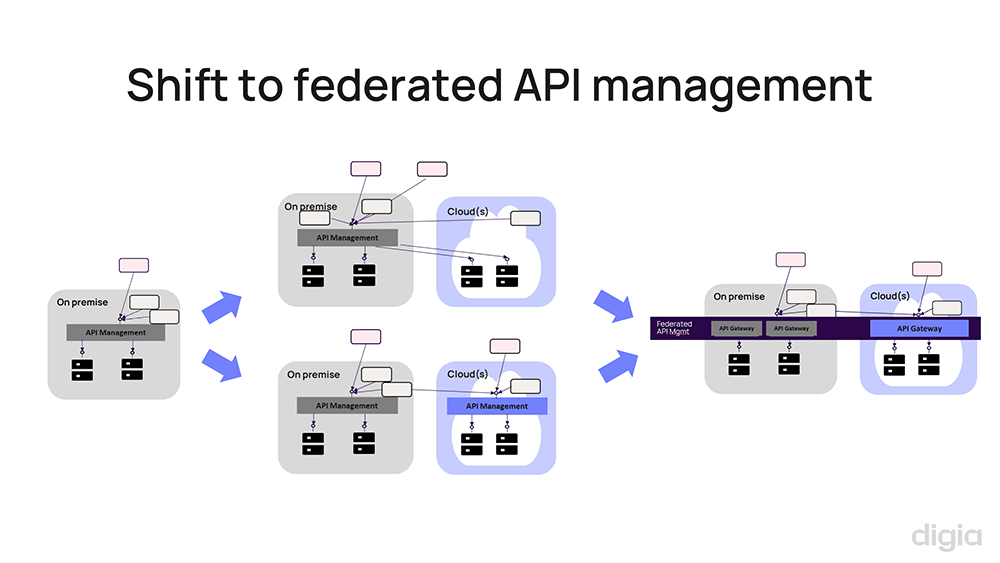
As APIs became mainstream in the late 2000s and early 2010s, most organizations implemented a single, central API management platform. Typically, this meant one enterprise-grade gateway running in an on-premises data center.
Then cloud happened, and organizations ended up with one of two setups:
- Using their on-premises API management to also publish cloud-based APIs
- Deploying a separate, cloud-native API management solution alongside the existing on-prem one.
Both setups are imperfect. In the first, there is a lot of traffic going back and forth between the data center and cloud. In the second one, there are two technologies and domains for API management.
What we see now is the shift to federated API management. In a federated model, the control plane is separated from the runtime. So instead of forcing one gateway technology everywhere, a single management layer provides a unified view of all APIs while actual traffic is handled by best-for-fit gateways. This means that diverse cloud-native gateways and micro gateways can be used to extend your strategic API management platform without losing visibility, regardless of whether the APIs are running on-prem, in the cloud, in a Kubernetes setup, or even on API gateways from different technology vendors.
The benefits of federated API management include:
- Federated management layer: Single source of truth for APIs regardless of where or how they run.
- Greater flexibility: You can choose the right gateway for a specific need without losing visibility, governance, or control.
We see that when the federated management layer ties everything together, it enables using smaller, more purpose-fit gateways that better match the real needs. Some API management technologies that already support this kind of federated model are for example IBM and Boomi.
Trend 2: High-quality API catalogs are a must
In theory, API catalogs have always been meant to contain high-quality, clearly documented APIs. In practice, however, many organizations got away with minimal documentation until now. APIs were often built for one or two known consumers, close to the development team, so everyone “just knew” how things worked, and you could always ask. That’s really not enough anymore.
Today, we see quality requirements rising sharply because of self-service development teams and AI-agent-driven usage.
Speed is the main driver behind the focus on API catalog quality. A high-quality catalog enables true self-service: designers, developers, and integration teams are expected to discover and adopt APIs quickly, often without any interaction with the API owners. Any missing details create friction and delays that modern delivery models cannot afford.
AI consumers. AI agents cannot ask for an onboarding meeting but rely entirely on what is described in the catalog. Specifications, examples, error handling, and authentication flows must all be precise and complete.
For many organizations, APIs are also a business channel. In banking, logistics, and the public sector, APIs can be a primary way customers access services. Therefore, a poor API catalog directly impacts revenue, and API users may switch providers. In this sense, the API catalog is not just a technical documentation but part of the product experience.
What defines a high-quality API catalog? Solid documentation and well-defined specs are only the baseline. On top of that, catalogs must include:
- Examples
- Error-handling description
- Authentication flows described
- Service level agreement/promise, together with terms and conditions
- Business-oriented categorization to quickly find what is needed
- Lifecycle information: when will it go live, when will it be deprecated, when is there a need to switch to a new version.
Catalogs should reflect APIs as products, designed top-down with a clear business purpose, rather than bottom-up from implementation details.
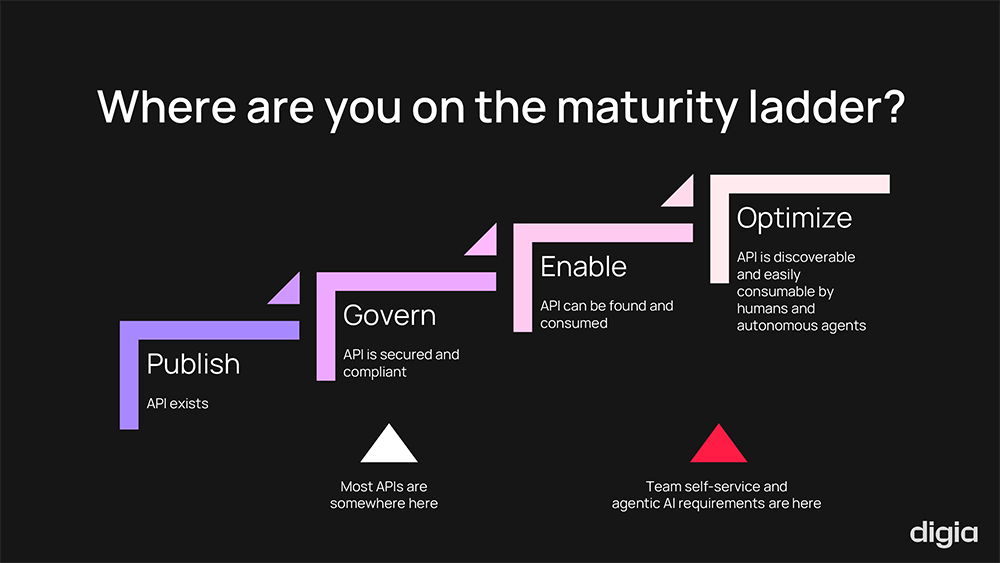
The irony is that many organizations believe their API catalogs are already high-quality until someone actually opens them. We challenge you to check 2-3 random APIs in your catalog and assess if the bullet points above are met. If so, you’re one of the few. Congratulations!
Trend 3: AI-driven API consumption
As mentioned in the previous trend, APIs are increasingly consumed by AI agents. This fundamentally changes how APIs need to be designed, governed, and managed.
The key points we see here are:
-
Interfaces need to be well documented and described. As mentioned, AI consumers do not attend those usage onboarding meetings.
-
Prepare for traffic spikes. AI-driven consumption can introduce sudden traffic spikes that traditional architectures are not ready for. This makes it essential to design rate limiting and traffic controls into APIs.
-
Error handling and error messages to guide agents. When an AI agent hits a rate or error threshold, the API should clearly signal what happened and when it is safe to retry. Otherwise, the agent may continue calling the API in a tight loop.
-
Strong security controls. Include properly scoped access and short-lived tokens, and design the security model so AI agents can act on behalf of users in a controlled and auditable way.
-
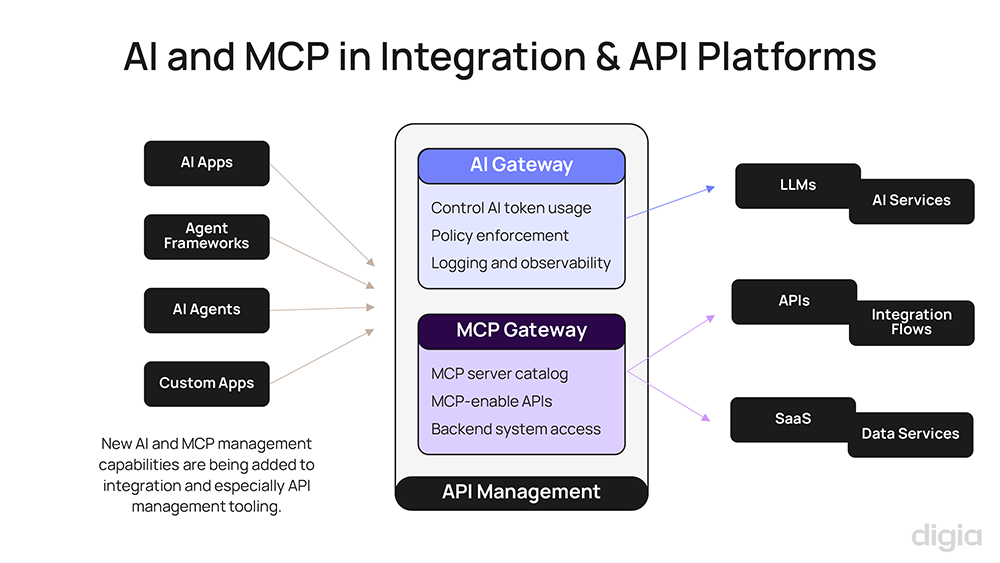
Control over LLM traffic. Visibility and management over token usage, blocking malicious prompts, and even dynamically choosing the best LLM model and provider based on cost, performance, and the model’s capabilities. We are already seeing this implemented in practice using platforms such as Azure API management together with Azure AI gateway. Most modern API management solutions now include built-in capabilities for managing AI traffic.
-
Design APIs for agents: think “experience API layer”. On top of your core APIs, it often makes sense to introduce a separate set of APIs tailored for AI consumption. These higher-level interfaces are easier for open-ended queries, such as finding all the red cars in an inventory without iterating though all the items with separate API calls.
New standards and patterns are emerging. The Model Context Protocol (MCP) published late 2024 is one example of how APIs can be described in a way that is more natural for AI agents to understand. Unsurprisingly, we now see API management and integration platforms adding MCP support in addition to the already available AI gateways providing dedicated controls for AI traffic.
The key takeaway here is very simple: AI will use your APIs whether you are ready or not. You can choose to be surprised by uncontrolled usage – or deliberately design, govern, and expose your APIs in a way that makes AI usage safe and valuable.
Trend 4: Maturing API security models
The role of security has grown significantly over the past decade, as APIs have become the backbone of digital platforms and ecosystems.
We have now advanced to the fifth stage in API security, which is largely driven by AI consumption.
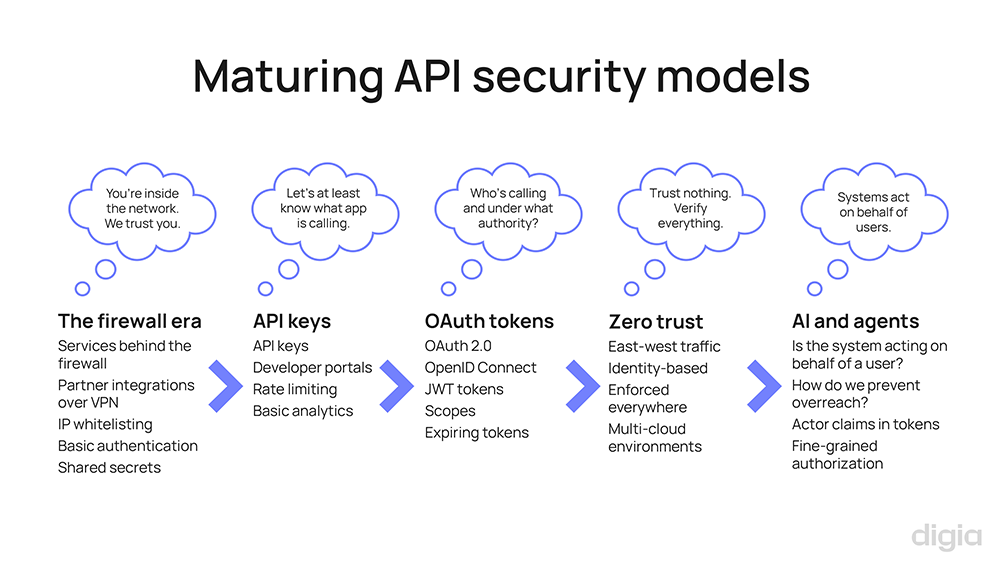
AI agents acting as API consumers introduce new security challenges. Traditional scopes and roles are often not precise enough when AI is acting on behalf of a user. For example, allowing an agent to initiate payments may require constraints tied to a specific account, transaction type, or maximum amount, and only for a very short time window. Context-bound, narrowly scoped, and short-lived credentials are becoming essential to prevent unintended actions.
Runtime security architectures are also evolving. The familiar layers of WAF (Web Application Firewall), API gateway, and application-level security remain but are now augmented with new capabilities. Application and API Security Posture Management (ASPM) tools now monitor API behavior over time, detecting anomalies that traditional signature-based protection cannot catch: unusual call sequences, unexpected parameter usage, or abnormal access patterns. These can be identified and flagged before they cause damage.
At the same time, APIs are increasingly integrated into broader security operations. Customers now expect API management platforms to feed logs, metrics, and security events into their SIEM (Security Information and Event Management) solutions, making APIs a first-class citizen in enterprise security monitoring. We also see convergence at the edge, with modern WAAP (Web Application and API Protection) solutions combining WAF, bot detection, and behavioral analysis to protect APIs before traffic even reaches the gateway.
The overall direction is clear: API security is no longer just about protecting endpoints, but about continuously managing identity, behavior, and risk across humans, applications, and AI agents alike.
Trend 5: Industry standards shape APIs
We are seeing a slow but steady shift towards industry standardization. Historically, each company built its own APIs, which led to slightly different interfaces, data models, and semantics, and therefore a lot of inefficiency when building integrations.
We see three main drivers behind the rise of industry standards:
-
Regulation. This is especially visible in financial services. Open Banking is a prime example: APIs mandated by regulations such as PSD2 (revised Payment Services Directive) require banks to expose standardized interfaces for account access and payments. While initially driven by compliance, these standards have proven highly valuable in practice. They enable payment hubs, KYC (Know Your Customer) services, and fintech platforms to integrate with multiple banks using the same API shape, which dramatically reduces complexity and time to market.
-
Industry-led collaboration. Standards have emerged organically in many sectors where there are several stakeholders involved, such as producers, suppliers, sellers, and operators. These standards are not always enforced by regulation, but by shared interest: interoperability benefits everyone in the ecosystem. Examples include energy markets with centralized data hubs, gas industry standards like EDIG@S, or railway and mobility standards such as OSDM (Open Sales and Distribution Model) for ticketing and travel information to name a few.
-
Modular, plug-and-play architectures. Here, standards define not just APIs, but reusable building blocks for entire enterprise architectures. Banking standards like BIAN (Banking Industry Architecture Network) and telecom frameworks from TM Forum fall into this category. They provide common data models, API specifications, and reference architectures that make it easier to assemble platforms from multiple vendors. While customization is still inevitable, these standards significantly reduce the effort required to compare capabilities, integrate systems, and evolve architectures over time.
While standardization is nothing new, the importance of the industry standards is higher than ever. Over the past two to three years, we’ve seen industry standards influencing APIs in practice across multiple sectors. That shift also signals a broader maturation: these industries are no longer just experimenting with APIs but actively shaping how APIs define the future of collaboration within their ecosystems.
Want to know more?
Explore our integration services and get in touch. We’ll help you build change-capable architectures.
See also our webinars: