








Integration needs are growing rapidly, and traditional approaches no longer work as pace of change accelerates. How can a centralized integration platform help your organization stay competitive? We interviewed Business Manager Sanna Mattila and Account Executive Jyri Junnola, who have worked with integration and API management services for a combined total of 35 years.
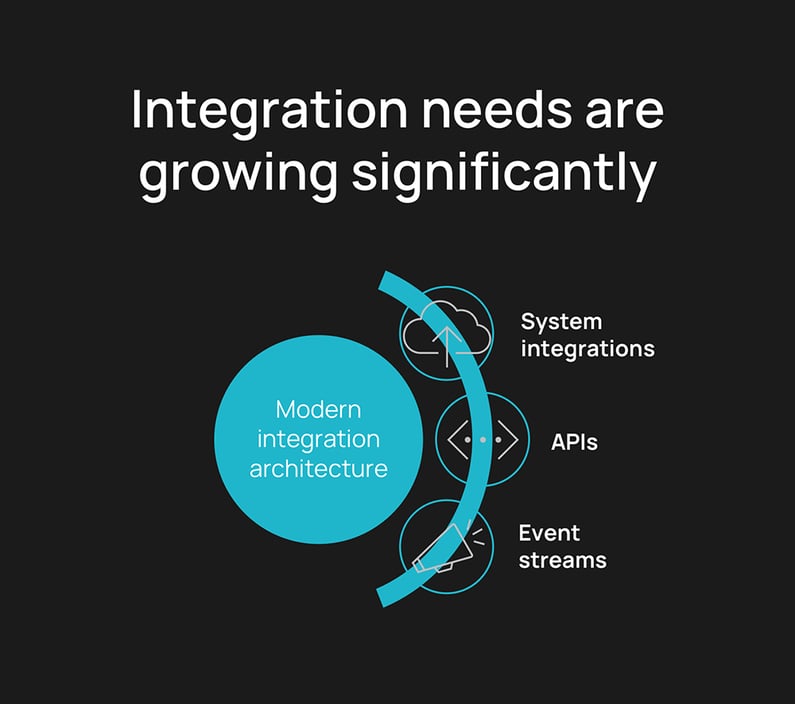
Integration needs are growing significantly
Why is the number of integrations and API services growing so dramatically?
“Several factors are driving this. Digitalization is of course the biggest driver, as organizations want to deliver higher-quality and more real-time services. Additionally, AI development is extremely active right now, and it requires the right kind of data to function. Then there are legal requirements, such as the Information Management Act, which affects many public sector organizations. To comply, data must be retrieved from multiple sources and shared with various stakeholders: authorities, other public sector actors, citizens, and partners,” explains Mattila.
“The service development perspective is very prominent among our customers,” Junnola continues. “In digitalization initiatives, organizations want to change the way they deliver services so that customers receive the right service proactively at the right time. And this naturally requires a better understanding of customers in the background. So there’s an increasing need for moving data to make operations more customer-centric than before.”
You both mentioned digitalization. What role does integration development play in it?
“A few years ago, Gartner’s VP Massimo Pezzini said that integration work would account for 50% of the time and cost of building digital platforms. And our own observations do support roughly that figure,” says Junnola. "This naturally means that the ability to deliver integrations quickly and cost-effectively is a cornerstone of service development."
Traditional model vs. Centralized integration platform
What role does a centralized integration platform play?
“If you look at a more traditional architecture where integrations are built from every system to every other system (point-to-point), you quickly end up with a spider web even with a small number of systems. And the reality is that there are easily tens, hundreds, or even thousands of systems,” Mattila summarizes.
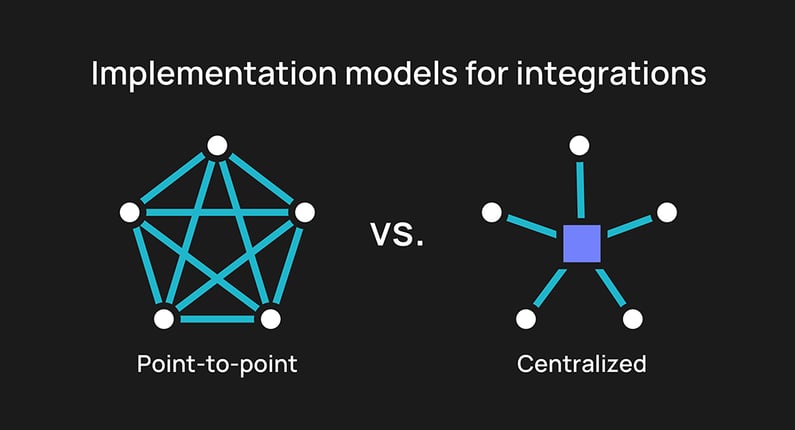
“For example, one large Finnish organization had 4,500 integrations before their system renewal, all implemented using this traditional point-to-point model. You can imagine how difficult it is to change one piece of the puzzle or make updates to the overall architecture,” Junnola describes.
“In a centralized model, integrations are routed through and managed a single technical platform and service, which makes the model significantly simpler, more manageable, and more efficient,” Mattila adds.
Benefits of a centralized integration platform
How would you describe the concrete benefits of using a centralized integration platform?
“Service development speeds up and becomes possible in the first place, when it may have previously been completely stuck in some area. In other words, the organization’s change capability improves, and technical bottlenecks are removed. That is of course a huge driving force for progress,” Junnola begins.
“Major system renewals become much more straightforward. Replacing or upgrading a core system like an ERP is more manageable and cost-effective when integrations are centralized,” Junnola continues.
“Security aspects are becoming increasingly important, and in a centralized model, security is also easier to manage,” Mattila adds.
“There’s also less need for changes on the application side. This means expertise scales better, which reduces dependency on individual people. External teams can be more easily scaled up or down as needed, or transferred to a different vendor if necessary,” Mattila explains.
“When integrations work, the so-called digitalization engine can run at full speed,” Junnola concludes.
Want to learn more?
Explore our integration services and get in touch. We’ll help you build change-capable architectures.
See also webinar: AI in integrations